
The Sky Was Never a Commons. It Was Always a Covenant.
Every device has a master. The question is whether you know whose name is on it before you let it into your sky.

China does not need to invade. It has already shipped the invasion. It is in your neighbour's garden. It is heading for your roof. It is inside the turbine on the hill above your town. The factory gate was never the border that mattered.
The right to own property, the right of the individual to make decisions for themselves and their families, and the freedoms the West holds up as worth defending: these do not maintain themselves. If they are not actively protected, they get eroded at the margins. Quietly. Incrementally. And before you can say no, you are already part of the matrix.

Drones are tools that can genuinely help communities. New economic opportunities. Reduced traffic. Blood and organs are delivered faster than any ambulance. A morning coffee to your door. But drones need permission to operate in low-altitude airspace. They need permission from the property owner. They need permission from the individuals below. That is not red tape. That is the beauty of the right to own and control what’s yours, and for a community to own and control its air rights. When drones fly without that permission, they are doing something older than technology. They are taking property they do not own, redistributing gains at the expense of individual freedom, and doing it in the service of whoever wants centralised control. That is not innovation. That is a political act dressed up as a delivery service.
The solution is not to ban drones. The solution is to build a system where towns, communities, and individuals decide how their airspace is used, on what terms, and who gets paid when it is transited. Not drone companies arriving like uninvited guests and calling themselves Florence Nightingale. Permitted transit. Approved hardware. Communities own air rights that can now generate value for the people beneath them, rather than extracting value from them. The question is whether it’s embedded before the wrong hardware gets its claws in so deeply that the choice disappears.
There is a tidy categorisation that the drone industry likes to use. Commercial, hobby, and military. Three lanes, clearly marked, nothing to worry about. It is a useful fiction. What you call a hobby drone, a defence analyst calls a platform capable of military-type operations. Commercial drones carry payloads. Those payloads do not have to be coffee. They can be munitions. The lane markings are administrative. The hardware does not care.
China understood this early and built its entire industrial strategy around it. Military-Civil Fusion, codified in law in 2017, legally mandates that every Chinese civilian company share its technology, data, and hardware with the People’s Liberation Army (PLA) on demand. Not as a courtesy or voluntarily, but by law. The dual-use nature of Chinese hardware is not a design flaw or an unintended consequence. It is the architecture and its policy. And the hardware being discussed is not confined to military procurement programmes. It is the drone hovering above your neighbour’s garden. It is the delivery vehicle heading for your roof. It is the module inside the turbine on the hill above your town.
The evidence is not hard to find
In December 2025, the civilian container ship Zhongda 79 was photographed at Shanghai’s Hudong-Zhudong shipyard undergoing military hardware installation. Containerised weapon modules, close-in weapon systems, and vertical-launch systems with radar. The Chinese markings on the equipment translated to “containerised weapon module development kit.” The ship appeared equipped with 60 vertical-launch system cells, with collaborative-combat aircraft drones visible nearby. Chinese and Hong Kong-flagged container and dry bulk vessels total 4,339 ships, roughly 20 percent of the global fleet. The U.S. flag total in those same categories is 63.

The Zhu Hai Yun sails as the world’s first civilian drone carrier for ocean science. China describes it that way. It has also operated in the Philippine sea zones without authorization. The vessel deploys more than 50 aerial, surface, and underwater drones to conduct 3D reconnaissance across nearly 100 miles. The civilian science framing falls apart quickly. Zhuhai Yunzhou Intelligence’s founder described his firm as “a model of military-civil fusion,” built to “lead the military with civilian innovation.” The company worked with the PLA Navy Marine Surveying and Mapping Institute in Antarctica. It supplied unmanned ships to Harbin Engineering University, a PLA feeder institution sanctioned by the United States in 2020.
The Jiutian is an airborne mothership capable of launching more than 100 drones per mission. Sixteen tons. A 25-metre wingspan. An operational ceiling of 15,000 metres. Twelve hours airborne. Targets up to 7,000 kilometres away. Chinese sources describe its dual-use roles.
Cars as drone launchpads
In March 2025, BYD and DJI launched the Lingyuan system, a roof-mounted drone dock integrated directly into BYD vehicles. A 4K drone in a rooftop station. Takeoff and landing while the car is moving at up to 25 kilometres per hour. The concern is not that BYD has become a drone manufacturer. The concern is that consumer automotive platforms are being fused with deployable drone infrastructure, normalised through the language of lifestyle and convenience, and distributed at scale into Western cities before anyone has asked who controls the off-switch. DJI is on the U.S. Department of Defense’s Section 1260H list of Chinese military companies. Features like autonomous tracking, AI navigation, and rapid vehicle-based deployment are consumer-facing on the surface. They mirror battlefield Intelligence, Surveillance, and Reconnaissance (ISR) requirements underneath.
A September 2025 report from the Center for Security and Emerging Technology documented a web of smaller Chinese tech companies operating across both domains simultaneously. Beijing SOUVI Information Technology received PLA contracts for drone control systems and intelligent sensing software that enable a single operator with minimal training to steer a swarm of drones. JOUAV markets vertical takeoff and landing drones with AI-fused thermal sensor data, enabling a non-military crew aboard a fishing vessel to detect other ships at night or in poor weather, turning a civilian boat into an intelligence, surveillance, and reconnaissance node.
The Pentagon’s annual China military power reports have flagged China’s civilian roll-on roll-off fleet, the same ships used to export BYD cars to Europe, as dual-use amphibious assets. Between May and July 2022, two Chinese civilian RO-ROs participated in exercises involving a floating causeway system designed to disembark forces onto a beach without seizing a port. The dual-capable civilian fleet could exceed the combined displacement tonnage of all U.S. Navy amphibious assault ships.

In October 2024, China formalised what was already true. New Export Control Regulations on Dual-Use Items, effective December 2024. Drones, AI. chips, quantum computing, EVs, and rare earths. Beijing put it in writing: these are national security instruments, not just commercial products.
“A really efficient totalitarian state would be one in which the all-powerful executive of political bosses and their army of managers control a population of slaves who do not have to be coerced, because they love their servitude.” - Aldous Huxley, Brave New World
This is where approved hardware lists stop being bureaucratic annoyances and start being acts of sovereignty.
If a drone wants to transit the airspace above a town, above a family’s property, above a hospital, a school, or a reservoir, the community below should know exactly who and what is overhead. Who manufactured it, under what legal framework that manufacturer operates, and whether a state adversary holds a legal claim on the device’s cooperation. Is the operator complying with local rules and community regulations, and can the property owner then choose to permit its entry or exclude it? That is not paranoia. That is the minimum due diligence any property owner would apply to anyone crossing their land. The sky is not different because it is invisible. It is property. It generates value. It carries risk. It deserves the same framework of rights and permissions that applies to the ground beneath it.
No permit, no transit. No transit, no revenue. That is how property rights work. That is how air rights work.
The Secret Service has eyes
Sir Richard Dearlove ran Britain’s foreign intelligence service during the peak years of China’s economic opening into the West. He personally led the effort that eventually led to Huawei's removal from the U.K.’s 5G programme. He is not someone who recently stumbled onto this issue. When he writes in The Spectator that Chinese cellular modules embedded inside civilian hardware, EVs, wind turbines, and grid switching systems can all be reprogrammed remotely by the Chinese manufacturer after installation, without the knowledge or consent of the operator, that sentence carries forty-five years of professional weight behind it.

“Less obvious but more serious in my professional view, and that of those whose task it is to watch our potential enemies, is the growing reliance within our electricity energy infrastructure on cellular modules made in the People’s Republic of China.” - Sir Richard Dearlove, The Spectator, 22 November 2025
The scenario Dearlove describes is precise. China invades Taiwan. The West enters a military confrontation with Beijing. Within hours, the CCP orders every Chinese EV on every British road simultaneously immobilised. Supply chains collapse. Emergency services stop. Military logistics fail. One decision. One signal. Civilian infrastructure becomes a weapon.
If that sounds like a thought experiment, here is the proof of concept. When Russian forces rolled into Ukraine and seized John Deere equipment, tractors, combine harvesters, and farm machinery, they loaded it onto trucks and drove it back across the border. They expected to use it. They did not. John Deere logged into its remote management system from an office in America and activated a kill switch. Every stolen vehicle stopped working. Not disabled at the border. Not intercepted in transit. Bricked remotely, after the fact. The Russians were left with expensive scrap.
The kill switch was not built as a weapon. It was an anti-theft feature, the kind of thing you build so a farmer who cannot make payments does not disappear with a $400,000 combine. It became a weapon anyway, because the capability existed and someone decided to use it.
Now scale it. Replace John Deere with a Chinese drone manufacturer operating under a legal framework that requires full cooperation with the PLA on demand. Replace a Ukrainian field with every sky above the United States. Replace one kill switch with modules embedded across tens of thousands of vehicles, grid switching systems, wind turbines, and drones, all reprogrammable remotely, post-installation, without the operator’s knowledge and without any ability to block it.
The capability exists. It has been demonstrated in an active war. The only question is whether it is deployed by a civilian company protecting its assets, or by a state that has publicly declared its intention to achieve global technological dominance by 2049 and legally mandates that its manufacturers cooperate when asked.
At the margins
Cheap EVs. Cheap drones. Promises of blood deliveries, organ transport, and morning coffee sent straight to your door. Up close, they are the infrastructure of someone else’s off-switch gathering data as they fly.
“The Chinese government is stealing its way up the value chain. It’s doing so at the expense of Western technology companies and Western workers and the Western way of life.” - Christopher Wray, Director of the FBI, 2022
The drone industry has a DJI problem. More precisely, it has a problem with people who do not think that DJI is a problem.
DJI holds somewhere between 70% to 80% of the global civilian drone market. It sits on the Pentagon’s list of companies allegedly supporting China’s military. It operates under China’s 2017 National Intelligence Law, which requires every Chinese company to cooperate with the PLA and state intelligence services on demand, no questions and no refusals. And yet a well-funded, well-organised effort has been running in Washington to ensure that none of that is treated as disqualifying.
Enter the Drone Advocacy Alliance. Multiple outlets reported that DJI took an outsized role in creating it. InfluenceWatch identified DJI as a sponsor and key force behind it. The Alliance’s public position was clean and simple: DJI drones are lifesaving tools, the bans are overreach, and the national security concerns are overblown.
In May 2024, Reps. John Moolenaar and Elise Stefanik wrote to Attorney General Merrick Garland asking the DOJ to investigate whether the Alliance should register under the Foreign Agents Registration Act, on the basis that it was lobbying on behalf of a Chinese military-linked company while systematically downplaying DJI’s ties to the PLA and CCP. Their letter was direct. DJI was using the Alliance to market its products as benign, while the lawmakers argued the opposite was the case.
That is an allegation by two members of Congress, not a court finding. No charges. No registrations forced. Whatever investigation followed produced nothing public.
But that is not really the point. The point is the architecture. A Chinese company with documented military ties funds an advocacy group. The advocacy group lobbies against restrictions on that company’s hardware. A prominent drone media voice, DroneXL’s Haye Kesteloo, one of the most widely read people in the industry, publicly opposes the bans and then, in June 2024, announces DroneXL has joined the Alliance. Nobody is obliged to assume bad faith. Kesteloo has not been accused of being a foreign agent or a registered lobbyist.
But those who have been watching China’s playbook for longer than the drone industry has existed will recognise the shape of this. You do not need to bribe or secretly recruit anyone. You just need the information environment to stay friendly while the hardware gets embedded deep enough that removing it becomes politically and economically unthinkable. At that point, the kill switch question answers itself.
The answer to that architecture is not a louder argument. It is a better system.

“The most important thing to understand about the Chinese Communist Party’s strategy is that it is patient, it is comprehensive, and it is serious. We are not.” - Elbridge Colby, former U.S. Deputy Assistant Secretary of Defense, 2023
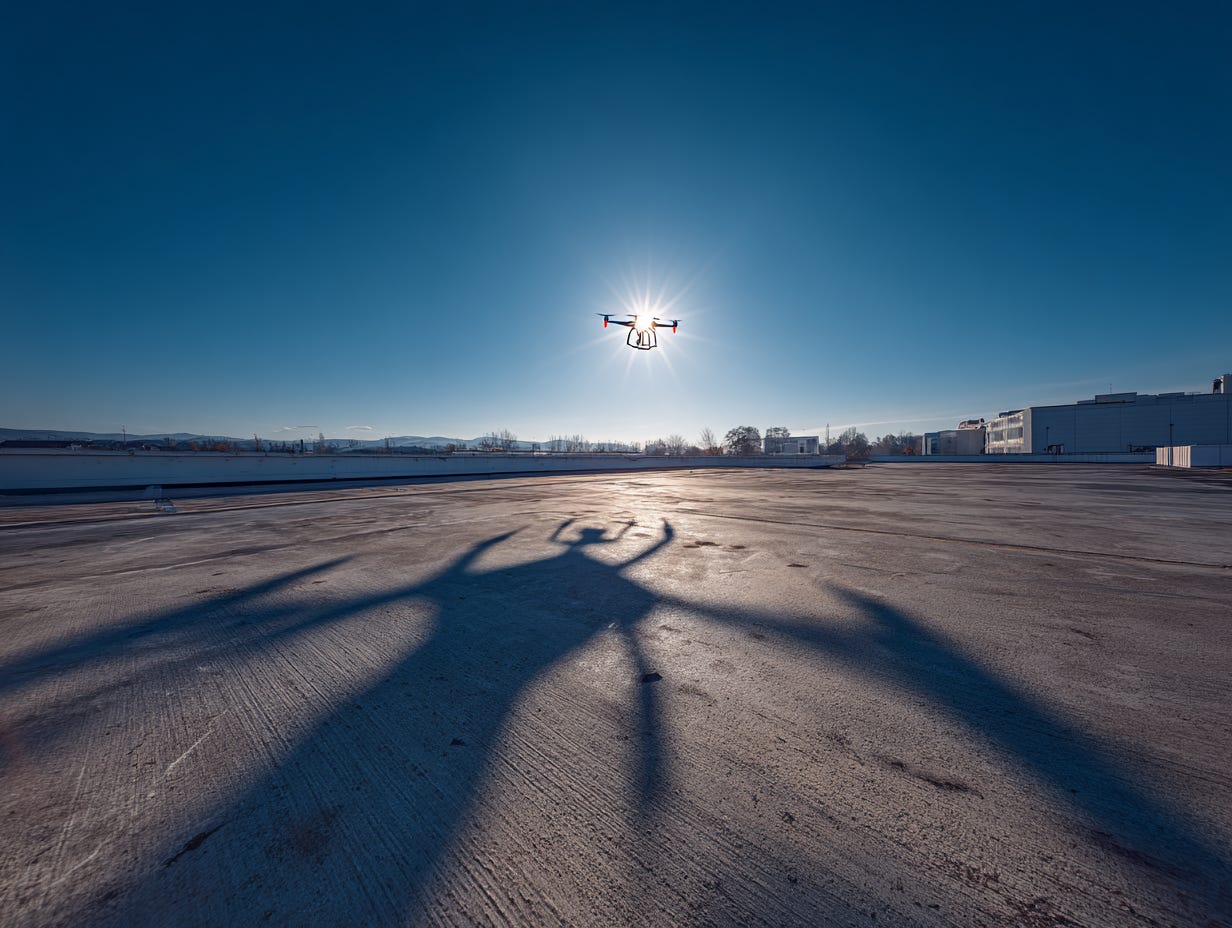
The drone companies that have been operating as if the sky is a commons they are entitled to cross without asking, framing themselves as emergency medical services while quietly building dependency on hardware that whispers to Beijing, are describing a world where their convenience is your obligation.
That world only works if you allow the property-rights question to go unanswered long enough for the infrastructure to become a fait accompli. The drone operators taking property rights, knowing what is at stake, are the modern-day Mustapha Mond, and they are the mechanisms by which that question gets answered before the PLA arrives.
Who controls the low-altitude infrastructure that runs through everyday life, and what happens when that question is answered before most people even think to ask it? Property rights. Air rights. The individual’s ability to make decisions for themselves and their families. These do not announce their erosion. They dissolve at the edges, slowly, in the language of consumer convenience, clean energy, and lifesaving technology, until one morning the infrastructure that was supposed to serve you has a different master.

The hardware is already here. The law that controls it never left China.
The sky above your town is yours. The question is whether you claim it before someone else decides the matter for you, installs the off-switch, and tells you to be grateful for the delivery.